Written by Dr.Albana Greca Sejdini, Md, MMedSc
Your mini guide on Prostate Drugs
Prostate drugs are the drugs used for the treatment of prostate problems. With aging, there are 3 common prostate problems:
1. Prostatitis or inflammation of prostate gland
2. Enlarged prostate or Benign Prostatic Hyperplasia (BPH)
3. Prostate cancer
As the causes and manifestation of each prostatic problem differ, there are myriad drugs used nowadays for the treatment of prostatic diseases.
The following paragraphs will give you the whole background of prostate drugs.
I. Prostatitis means that there is an inflammation in the prostate gland, which might occur due to infection with bacteria.
Actually, there are four types of prostatitis:
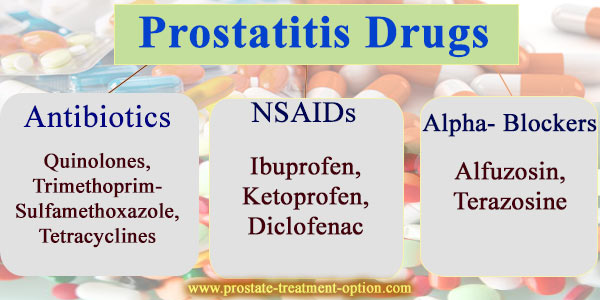
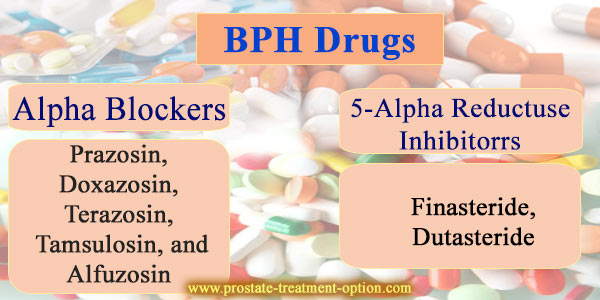
II. Enlarged prostate or benign prostatic hyperplasia (BPH) is abnormal cellular growth (not cancer) of prostatic tissue. Myriad prostate drugs are used for the treatment of BPH.
III. Prostate cancer occurs when abnormal cells undergo uncontrolled growth within prostatic tissue, forming a tumor mass. Usually, this type of abnormal cellular growth is supported by the male sex hormones (androgens), like testosterone and dihydrotestosterone (DHT). Hormone therapy (also known as androgen deprivation therapy (ADT) or androgen suppression therapy), are prostate drugs which can block or prevent the action of androgens.
It is proved clinically that reducing the levels of androgens in the body causes the cancer to shrink or delay its growth. Unfortunately, hormone therapy can’t cure the cancer completely.
In fact, hormone therapy is indicated in certain situations, including:
1- When surgical or radiation treatments fail to cure the cancer, because the cancer starts to metastasize outside the prostate.
2- Recurrent or persistent prostate cancers.
3- Hormone therapy is used as initial treatment combined with radiation therapy.
4- Prior of surgical or radiation treatments to enhance these treatments effects.
Though Orchiectomy or surgical castration is a surgical procedure, its effect resembles the effect of hormone therapy. In this type of surgery, the surgeon excises the testis (where 90% of androgens are formed), thus causing the prostate cancer to shrink or grow more slowly.
Types of prostate drugs used in hormonal manipulation are:
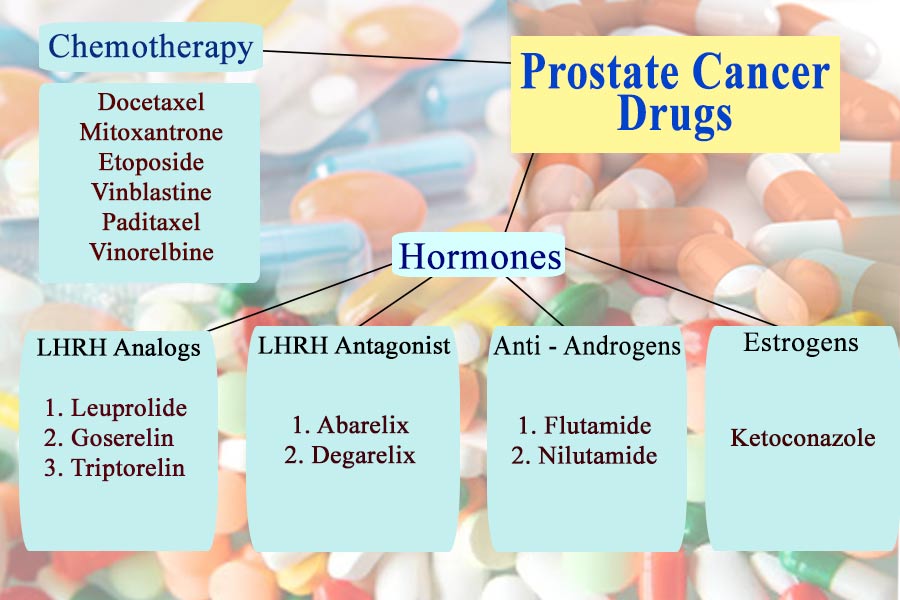
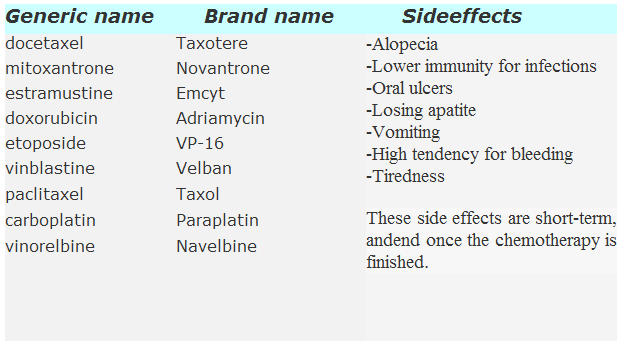
Chemotherapy is indicated when prostate cancer starts to spread or metastasize to other organs or tissues. Chemotherapy involves the use of anti-cancerous drugs, which are injected into a blood vessel or taken orally. These kinds of prostate drugs have the power to destroy the growing cells in the body.
Some of chemotherapy drugs used might include:
Related Pages:
BPH drugs – Get the detailed info you need
Learning about the Side Effects of Finasteride
Flomax Side Effects - Drug Interactions, Problems, Reviews
Cipro Side Effects Elucidated!
All about Hormone Therapy for Prostate Cancer
Premarin Side Effects - Male Hormone Replacement In Prostate Cancer
Prostate drugs Questions or Problems? Get Help Here!
Are you having Prostate drugs questions? This is the place where you can ask a question about any aspect of Prostate drugs.
What Other Visitors Have Said
Click below to see Question from other visitors to this page...
Prostanorm for Enlarged Prostate 
QUESTION : What is the role of prostanorm in the treatment of premature ejaculation and difficult erection?
ANSWER : Hi Mohammed,
First, let …

GRADE 1 BPH Treatment!
QUESTION : Hi,
I am 61 yr old male. Recently, ultrasound scanning found that I am having enlarged prostate grade 1 and bladder wall thickness of 5 …

Any Side Effects From Continuous Use Of Tamdura?
QUESTION : I am diagnosed with prostate enlargement in 2011. I was prescribed Tamdura 1 capsule per day. There is good improvement. I am taking this Tamdura …
TAMDURA MEDICATION FOR ENLARGED PROSTRATE Not rated yet
QUESTION : Dear Sir,
Since last 3 years I am having enlarged prostate, where some residue of urine is remaining.
Since I am suffering from diabetes, …
what are side effects of 'Naoflow capsules' (maybe error in spelling) for enlarged prostate Not rated yet
QUESTION : Shall use the medicine for the first time for enlarged prostate (age 65 yrs).
I have normal or slightly low blood prresure.
I am worried …
Hormone and Lupron Treatment Side Effects and Brand Name Drugs for Enlarged Prostate Not rated yet
QUESTION : I want to know all the brand name drugs for enlarged prostate problems. Are they in the list you provided above or exist other names?
…

What Are the FDA-approved Drugs for Prostate Cancer? Not rated yet
QUESTION : Can you provide a list of FDA approved drugs for prostate cancer? For early and advanced stages of prostate cancer? Thank you.
ANSWER …
Recent Articles


-
Can Gleason score 3+3=6 (Grade group 1) be cured or cancer eliminated altogether?
Hello, Given 13 cores taken 5 showing Prostatic adenocarcinoma. All same Gleason score as noted. JD -
Kegel exercises for enlarged prostate
 Kegel exercises, also known as pelvic floor exercises, are often recommended as a non-invasive treatment for men with enlarged prostate or benign prostatic
 -
What happens during prostate exam, ultrasound and MRI?
What happens during prostate exam? A healthcare provider, usually an urologist, will evaluate the size,shape,and texture of the prostate gland


